Thursday, October 21, 2010

Time Flies When You Can't Keep Up!

It's almost my bed time, but I have to get some of these ideas and notes down in black and white before I blink and Del has entered yet another new stage that I won't find time to document. Consistency is key in parenthood. . .or so I've been told. . .and it's apparently something I'm still attempting to achieve! Let me touch on some of the milestones we've checked off since last time I posted.

Vocal Development
Del continues with her screeches, squeals, and growls. She is also having a lot of fun playing around with the sound her saliva makes when she sucks air in through the sides of her teeth. This is another non-linguistic sound - like raspberries or screeching - that I like to call her "voiceless ingressive lateral salival frication." If you don't understand why I call it that, consider yourself lucky; it means you're not a big dork like me! Del has added another (somewhat terrifying) non-linguistic sound to her vocal repertoire. She likes to suck in air through tightly constricted vocal folds, creating a sound that closely resembles that of a baby gasping for breath. With the whooping cough scare running rampant in California, I was admittedly freaked out when I started hearing her make this noise. After careful observation of both her overall health and the instances where she made this unfortunate noise (unfortunate because she loves it and yet I'm left questioning whether or not to rush her to the doctor), I've concluded that she's just plain having fun with all of her noise-making parts, and most likely delighting in the reaction this particular noise gets out of her mama.

Del continues to play around with canonical babbling (meaning she babbles repeatedly on the same consonant-vowel syllable such as /ba/), and in addition to the sounds mentioned in my previous post, she has played around with the phonemes /f/ (as in "fun") and /ŋ/ (as in "sing").  The /ŋ/ sound is not used at the beginning of syllables in English (like it is in some languages, such as in the Vietnamese last name "Nguyen"), which has not yet prevented Del from using it in that position when she babbles on the syllable /ŋa/. This is an interesting indicator, suggesting that at seven months of age she has not yet mastered the syllable structure of her native spoken language. Research has suggested that infants can distinguish between the phonemes of their native language as early as four months of age (called categorical perception), and that around six months they begin to hone in on the sounds that are used in their native language as distinct from the sounds (and the rules governing how those sounds are used) of other languages. In other words, Del may understand on some level that /ŋ/ is not a sound used at the beginning of words in English, but her developing mouth and mind are still playing around with it in all ways possible and will figure out the sound's true linguistic role in English somewhere later along the way (dear readers: references and more information on this subject would be greatly appreciated!)

Del is playing around a lot more with pitch variation on prolonged vowel sounds, and has begun to "sing" along with me when I'm singing. She will participate in conversation with me, taking 4-5 conversational turns with whatever noise she's making at the time, and gets especially excited when I'm talking and signing at the same time. She recently engaged a friend of hers who is the exact same age (born within an hour of each-other) in a conversation. The two of them talked back and forth for three conversational turns before they turned their attention to other things. I was amazed that our tiny babies had such confidence and control with their language, and that they obviously didn't need us big clumsy adults to interfere when they wanted to have a nice chat! 

Manual Development
Del is absolutely delighted by her fingers. She will often bring her fingertips together at a quiet time during the day, such as right before a nap or during nursing, and gently alternate fingers as she calmly continues to gain dexterity and speed with her fine motor skills. It's fascinating to watch her manual play for linguistic signs, wondering what she makes of the two languages in her life, and what it is she's trying to say to us when she makes the "F" handshape (palm facing out with thumb and index finger connected in a circle) three times in the span of a few minutes and presents it to us with glee and pride. We joke that it's because her first sign is her daddy's name sign (which is formed with the "F" handshape), but realistically we have not for certain seen a first sign yet. Both Daddy F and I reported to each-other on the same day that we think she signed "daddy" with an "L" handshape on her forehead (the real sign for "daddy" is all fingers extended with the thumb on the forehead), but we're not going so far as to claim first sign quite yet; I guess we're not completely convinced of it's linguistic intent. . .either that or we're in denial of how fast our baby is growing and learning! At any rate, it's clear that Del is aware of her signing space, and various hand shapes, and is now showing signs of awareness for placement of signs (i.e., her forehead).

Del becomes very obviously and immediately excited when she sees someone signing to her on the VP. The video below shows just how delighted she is by her participation with signed communication, and exhibits a few rounds of turn-taking in her manual-babbling "conversation" with her grandpa. 


Thursday, October 7, 2010

Hand babbling "evidence" ?

Not a month into this blog and I've already fallen behind my weekly post commitment! Ah well, such is the life of a new (working) mother. Here I sit at 8:30, ready to put some thoughts to type, and it feels like midnight. . .or later.

After reading back through my previous post, I realize I have to offer one more disclaimer, and to warn of many more likely to come! It is intimidating to write about something so detailed and intense, and about which i admittedly am no expert. I imagine in the course of this blog's life that I will have to put my proverbial foot in my mouth more than a few times. This disclaimer is an important one that will hopefully save me from having to defend myself against accurate accusations that there is no such thing as the typical child. The disclaimer is this: when I write about a sound "typically" being used first in babbling, or that a child will "typically" learn one particular sound before another, please take those statements with a big fat grain of salt. While there are well-documented patterns in English language acquisition, there is also a great deal of individual variation, and most children are idiosyncratic in some way or another in what they say or do when compared with other children their age. For example, although Del started using /b/ as her first consistently babbled phoneme, which is in line with so-called typical phoneme acquisition for English, she also started making "raspberries" after she started babbling in earnest, which is opposite of the typical sound exploration we tend to observe.

At any rate, if you come across a statement that you disagree with, or a question of mine that you have an answer for (even if the answer is just a guess!), please share. If you have a random comment about one of your children, or your students, or about something vaguely language or baby or Deaf or new-parent related, share!

And with that, it's my time to share. . .another video! This one is brief because I am having a very hard time catching Del in her wild hand-babbling giddiness. When she's vocal-babbling or screeching in the other room I can hear her, and I run in with the video camera to try and catch her before she sees me and stops mid-screech. Since I can't hear her hand-babbling, I'm quite limited as to how much footage I can get of her exploring language with her hands. I'm further limited because she tends to hand-babble when she's either talking to Daddy F's family on the VP, or first thing in the morning while we're slowly waking up in bed, or at night when it's dark and she's lying down, quietly mesmerizing herself with her manual dexterity before she falls asleep. 

It's interesting to me that at six months, Del already seems to have a sense of when to use her voice and when to use her hands when attempting to communicate. She still demonstrates crossover when she vocalizes with Daddy F, but I think it's partly because Daddy F uses his voice a lot when they play and talk to each-other, and he makes silly sounds with her more often than I do. She hand-babbles with me because I both talk and sign to her, so it makes sense that she would use both communication modalities with me during her language development. I do notice lately, however, that when she is sitting with us talking to someone on VP that she rarely vocalizes and tends to get very active and excited with her manual babbling. If you are Deaf and have a hearing child, when did your child seem to "get" that s/he should only sign with you and other Deaf individuals, and speak when talking to someone hearing? It's a fascinating part of language development for bi-modal bilinguals. I have two friends who are Deaf with a hearing daughter. She both signs and speaks beautifully, but in all the time I have spent with her, she refuses to engage in spoken communication with me. Is it because she associates me with deafness because I'm usually the only hearing person and I am signing along with the other Deaf adults? Is it because she prefers to sign and will only speak when the her conversation partner doesn't know ASL? I have so much curiosity about these things and am eager to hear your stories and perspectives on the subject.


This is a (very!) limited example of what I consider to be Del's version of hand-babbling. The intro and exit parts of the video are her waving, with the middle portion demonstrating a little bit of her hand and finger play. I'll keep working on capturing a better clip with more finger play (that's my favorite thing in the world to watch but unfortunately her favorite time to do it is when she's breastfeeding!), maybe by keeping the camera close at hand when we have family on the other end of our VP. She's very astute and tends to stop doing whatever it is I'm trying to capture as soon as she notices me with the camera, so I'll have to improve my stealth-mode recording tactics, and quick! It doesn't help that our Flip video camera closely resembles her very favorite toy. . .my cell phone.

Saturday, September 25, 2010

Ba-ba-ba babbling!


Before I begin I want to clarify some linguistic terms. When we talk about sounds in language, we use the term phoneme to mean the smallest unit of sound that can convey meaning. For example, both b and p are English phonemes because "big" and "pig" mean two different things. When we write about phonemes we represent them in slashed lines, such that the phoneme for the sound in "mom" is written as /m/. As I talk about the sounds that Del is using I will use this linguistic convention to make things less confusing for me to write about as her language skills gain complexity. If something needs additional clarification, please let me know in a comment so that I can assure to the best of my abilities that every post I write is accessible to those with no prior knowledge of linguistics. Also, I have not yet been able to figure out how to add subtitles for those of you who are Deaf or HOH (which is not a huge deal right now because Del isn't yet talking!), but that is something I will be looking into and hopefully adding to future videos.


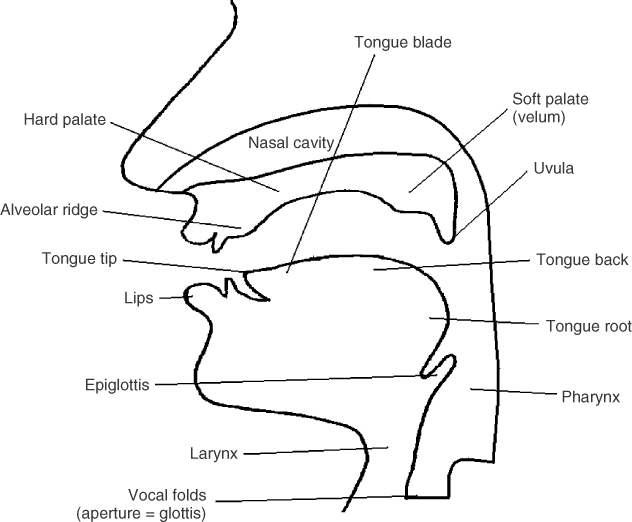
Now, onto babbling! Babbling in English typically starts with bilabial sounds, which are produced by bringing both lips together such as for the sounds /m/ and /b/. These sounds are easy for a baby to make because the lips are fairly large articulators, or parts of the mouth used for creating speech sounds, such as the lips, tongue, alveolar ridge, velum, etc (see diagram above for reference points for the various articulators). Bilabial sounds occur early in babbling development because using them for sounds production doesn't require a great deal of fine motor skill. The bilabial sounds that babies usually babble with first are voiced phonemes /b/ and /m/, which are produced with vocal cords vibration, as opposed to the voiceless phoneme /p/ which is produced without vocal cord vibration. To get a feeling for what this means, put your hand on your throat and hum on an /m/ sound. That vibration you feel is your voice turning on; your vocal cords vibrating. Now keep your hand on your throat and repeat a soft /p/ sound; see, no vibration!

In typical babbling development, /b/ will usually precede /p/ . I believe this is because it's easier for babies to simply turn on their voice for /a/ (all vowel phonemes in English are voiced) and then bring their lips together and apart to create the syllable /ba/, than it is for them to time the vibration of their vocal cords for a voiceless+voiced syllable like /pa/. Babies also tend to alternate early on in babbling between nasal phonemes, or sounds made with air flowing through the nose such as /m/ and /n/, and oral phonemes, or sounds made with air flowing through the mouth such as /b/ and /d/.  The reason that nasal and oral phonemes such as /m/ and /b/ are often interchangeably babbled is because these young babies have not yet mastered control of their velum, the soft flap of tissue way at the back of the soft palate that opens and closes the doorway between the oral and nasal cavities. The video posted here demonstrates our baby's (pretty darn adorable) version of this learning curve.

Del started her English babbling experience by exploring bilabial sounds /m/ and /b/ right around five months of age, give or take a week. This video was (luckily!) captured very early in her babbling career, for which I'm grateful because it demonstrates that she's still working on the timing of her breath support and the movement of her velum opening and closing, and is inconsistent with the sounds she creates. She seems to be gearing herself up to make sounds by moving her lips and tongue without any vocalization prior to the babbling. The video was taken about two weeks ago (on September 7th), which any fellow parent can attest is a lifetime in the rapid development of an infant! She is currently babbling more consistently with /b/ and /m/ sounds, and to date has also used the phonemes /n/ (as in "no"), /h/ (as in "hi"), /d/ (as in "dye"), /g/ (as in "guy"), /w/ (as in "why"), /j/ (as in "yes"), and the occasional non-linguistic "raspberry" that babies seem to love making so much! She also frequently squeals, screeches, and growls, delighting in the sheer noise she is able to create. Her vocalizing still occurs, but less frequently now that she has discovered the magical fun of consonants.

Her ASL babbling started around four months with frequent hand waving and finger play. As she grows, her hand movements have become smaller and more precise, with more of the movements occurring within the linguistic signing space in front of her body. She has recently started to experiment more with fine motor skills when hand babbling, and will hold her hands up in front of her face while she's playing quietly by herself and turn them around and make various hand shapes with one or both hands. To date we have seen her make the handshapes for the letters "A," "N," "S," "T," "L," and many of her own invention. She also will hold both hands up and rotate them around each other as if she is signing, "sign." My personal favorite is when she completes some kind of Del-invented hand sign and then holds it up to show us with the widest, most proud smile on her face. Yesterday Daddy F, Del and I were out for breakfast at a local greasy spoon. Del was sitting in her stroller, observing all the lights and lines around us while Daddy F and I chatted and ate our breakfast. There was a man sitting alone in the booth next to us who was exchanging smiles with Del. At one point she held up her hand with fingers spread and palm facing him and waved it a little - a classic wave. Then she made an "L" with her thumb and pointer finger, and pointed right at him, precise as could be! The only way it could have been better is if she had winked at him.

Saturday, September 18, 2010

The first stage of English: Vocalizing

This video was shot on July 7th, when Adelaide was just under four months old. It demonstrates her vocalizing (or cooing). She hadn't yet found her lips or tongue to start making consonant sounds with her articulators, but was having a great time playing with her voice day in and day out. Seems she is bound to be just as vocal as her mama. . .uh-oh! Here she is talking to me as she soothed her aching gums with a frozen teether while on vacation in Philadelphia. Incidentally, her two bottom teeth showed up just a few days later!

Adelaide's ASL development has been harder for me to recognize due to my unfamiliarity with early signing development and my reliance on my ears to key in on language, but she did start flapping her arms and touching her fingers together often sometime between three and four months. This is something we have not observed in other hearing babies (from hearing families) her age. I'm curious to hear about your experiences with ASL "babbling" and what that looked like, how it progressed, and how you identified it.

Friday, September 17, 2010

And so it begins. . .

I promised myself that I would start this blog the day Del turned six months, and I somehow managed to arrive on the scene a mere 24 hours tardy. But before I launch into what this blog is all about, let me share a little background info on us.

I am professionally a Speech Language Pathologist with an undergraduate background in Linguistics and a life-long love affair with all things language. I am hearing and know four languages (English, fluently; Spanish and American Sign Language (ASL) conversationally; German, poorly). My exposure to and immersion into the Deaf community began over three years ago when I met Daddy F. Daddy F is professionally an ASL teacher and rehabilitation counselor with an undergraduate background in Deaf studies and ASL linguistics. He is Deaf from a Deaf family and communicates primarily in ASL. He vocalizes within our home to get our attention or when playing with Del, but he doesn't use speech as a functional means of communication. Therefore, our daughter is the product of a hearing mother (me) and a Deaf father (Daddy F) and because she herself is hearing, she will be roughly equally exposed to both ASL and English.

So far her direct language exposure is more ASL than English because the language of our home is ASL, she has been home with her daddy most days while mommy is at work, and she has had ample exposure to Deaf and hard-of-hearing (HOH) friends and family both in person and on videophone (VP). Of course I talk and sing with her often, and she receives the ambient English (and Spanish!) exposure when we're out in the community that is part of the incidental language education of every hearing child.

This blog was borne of an intense curiosity on my part about how Del's language will develop. Because I know little of ASL developmental milestones for hearing children of Deaf adults, and nothing of simultaneous ASL/English bilingual development, I thought it would be fun to dive in and do a casual case study on our daughter while reaching out into cyberspace for information and insight into the many interesting factors at work here.

I am nowhere near an expert on child language development, English, ASL, or bilingualism. Rather, there is SO MUCH I don't know that I am inspired to learn as much as possible about these topics - hopefully with your help. My primary goal for this blog is to gather together a community of people interested in the same things so that we can build a forum of idea sharing and resource building. It will be informal and anecdotal, but the idea is that we will all learn something along the way. So I invite you to be an active participant in the days and discussions to follow, and to invite me into the worlds of knowledge that only you know. And so it begins. . .